
How I'm using AI in 2025
AI planning trips to Egypt, two-hour feature builds, one-minute product photos, and where humans still win
Hello friends!
AI is a wild west right now. No rules, no best practices, just emerging guidelines. And I kinda like it. It reminds me of building websites in the early 2000s. We were all figuring it out and making it up as we went along. Everyone had their own way of doing things.
I was talking to a friend on the phone and he was sharing his way of using AI, and it was so different from mine.
We are in the improv era of AI.
So this is an article to share how I'm using (and not using) AI, sprinkled with the usual personal updates and meanderings. Feel free to skip around to what interests you.
How I'm using AI
Coding
(Sonnet 4 and Claude)
It's really changed the game for coding. It's almost abstracted away the need for a programmer. I say almost, because you still need to know what's going on at the tech architecture level. Right now, I'm using the Claude 4.0 model within Cursor almost daily to build sites, apps, and tools.
At first, I built mixcard.me, which was exciting but still difficult. Six months later, I launched a very niche Australian insurance comparison site using AI and although being more complicated of a project, it was much easier to build: oshcguru.com.au (This opportunity came up through a business partner and I took on the technical role!)
Every time we needed a new feature, I could add it in a 1–2 hour sprint (for example: saving quotes). The site takes a very information-heavy, confusing process, comparing insurance documents for students, and helps them understand and choose the best plan.
From my last newsletter, I also mentioned I made a course teaching these tools, but I learned that things are getting outdated very fast. The features I was showing in video were changing weekly as I was making the content. I feel like the best path to teaching is to use it at a really high level, get results and share.
With coding, there are definitely evolving best practices. For me I use structure with various READMEs for each part of the app, and I'm thoughtful about what to include in the context window (the files you include and feed to the AI). More about context engineering at the end of this article.
I think the best way currently to share my best practices is through a living document about “How to code with AI”, so if you'd like access to that drop me a note in the comments.
Trip planning and using my airline miles
(ChatGPT 5)
Beyond technical work, AI has now replaced how I plan my trips and find flights.
I'm going to Egypt for the first time in 10 years!! But dang, I really dread long flights nowadays. I was able to ask AI what the best routes would be, and how I could potentially use miles.
ChatGPT directed me to pick a flight I wouldn't have otherwise because it had two stops. But for 90,000 miles it was first class all the way with Turkish Airlines, and the additional leg was just a quick stop in Istanbul. I'll be laying flat and arriving refreshed! My last trip to Europe I had actually hired a travel agent on Fiverr to figure out how to get a good reward flight.
I also had an extra week between my Egypt trip and a wedding in Boston. I could have done anything between Egypt and Boston so that's way too many options!
ChatGPT helped me narrow down Lisbon as a destination. It's about halfway (6 hours from Egypt to Lisbon, and 7.5 hours from Lisbon to Boston), and it has dancing, hiking, and art. A perfect one-week stopover for me! I'll be there in mid-September!
Product photography
(Gemini 2.5 Flash Image AKA Nano Banana)
Now that the Kickstarter for the board game is done, I needed to launch the ecommerce site, and I only had 1–2 workdays allotted to do it.
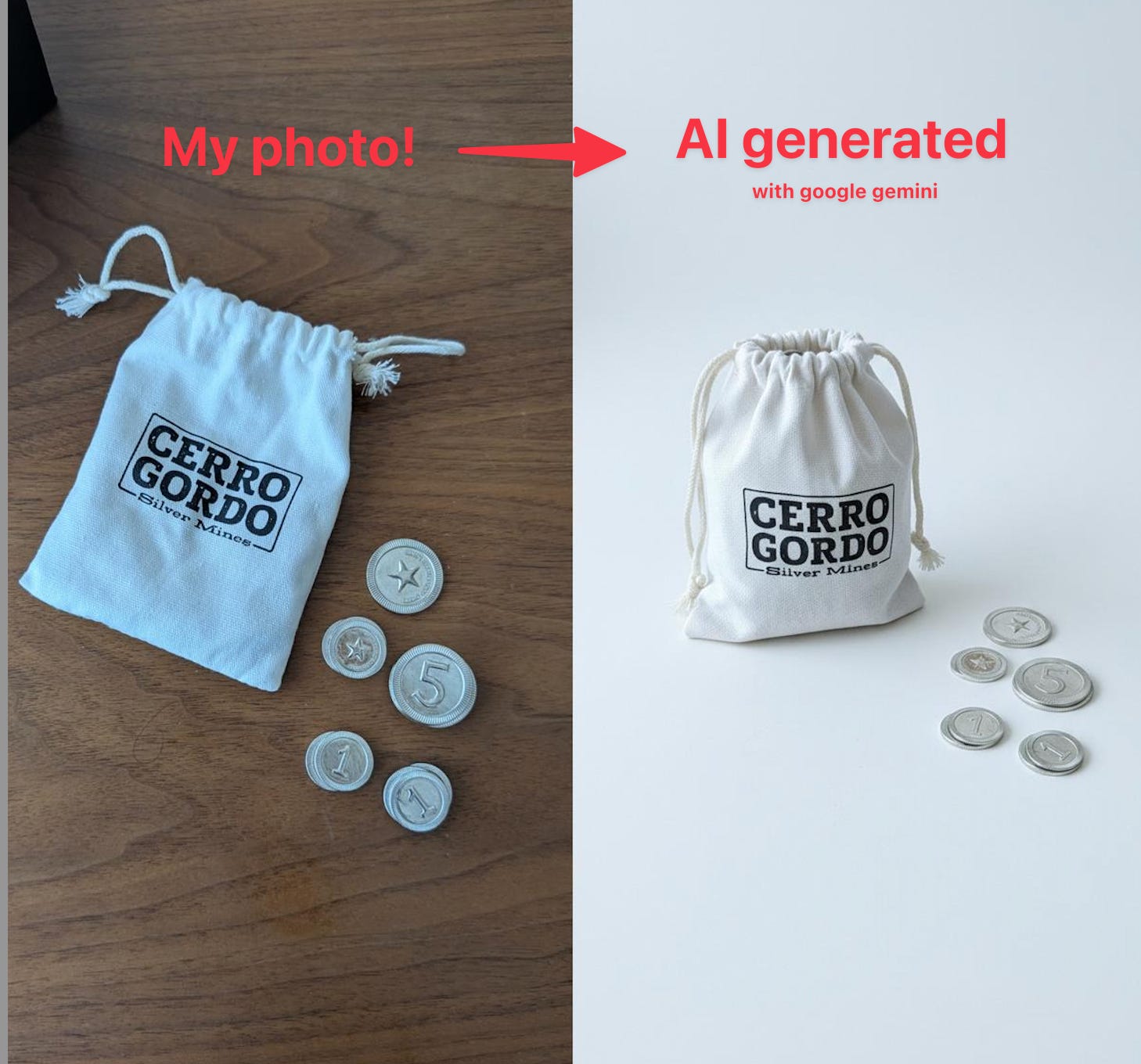
I was missing some product photos, and this image below is truly a 1-minute transformation from a quick cell phone snap to a website ready product photo! 😲😲
https://ghosttownlivinggames.com/
Previously, that would have taken planning, sending the product somewhere, waiting a week… What I love about this is that the barrier between idea and result is reduced to almost nothing.
Critiquing my creative work
(Claude)
I still don't recommend using AI for truly creative and expressive work (more on that below). But it's perfect as a critic.
You can input a website, piece of writing, or art, and it will give you a feedback of how the average person might view your work.
This is really helpful for someone like me who can get too swept away into an abstract direction. To make your work better, I recommend asking AI to ask you questions and point out what it thinks the best part of your work is, and where it's lacking.
There is a method for improving writing called the "Amherst Method" and you can have AI do it with you. Here it is below, and YES I used it to improve this article.
Sample prompt:

Use the Amherst Method: Briefly respond as a reader.
- What's strong or effective?
- What's confusing or unclear?
- What do you want to know more about?
Strategizing and brainstorming
(Claude and ChatGPT 5)
If I'm stuck on a business or personal problem, I'll often get another opinion using AI. This one really depends on what you feed it. Here I'll start a chat by inputting a document from my Notion around my goals, what I've already tried, and what my priorities are. Then I'll use the voice tool to externally process and blab at it in a five-minute voice note.
This can help me empty my mind, and AI is good at finding patterns and simplifying.
While the results are good for clarifying, or maybe helping you find a next step don’t expect anything truly innovative, or for the AI to solve all your problems.
There is a meme out there where someone asks AI, "Build me a millionaire company, I don't want to work, what do I need to do next, think deeply, take your time." This is not going to get you the results you want!
What you can expect it to do well is to help you narrow down ideas and consider a few new directions.
Other ways I use AI:
Recipes (I want to make pesto but don't have pine nuts)
Document translation as an expat (What does this document say in English and how should I respond to it)
Plant tips (taking habanero peppers from seed to seedling)
Facebook ad images (using ChatGPT to create a striking ad)
Evaluating business acquisitions (upload the prospectus and break down the opportunity)
Deep research (Help me understand the Australian insurance market)
Product comparison (What's the best consumer 3D printer on the market that's easy to use and won't break down)
Workout plans (Help me focus my back day around posture and thoracic flexibility)
Making quick songs with Suno (Make a bedtime song for my nephew Simon about running around the table)
How I'm NOT using AI
I’m not using it for writing important creative content
AI writing is still obvious. Yes there is the em dash—which I love using actually! But also it’s just average. Too perfect and impersonal.
Language is much more alive when it's infused with a unique experience and phrasing.
There are situations where it makes sense if you need to write something transactional and want it to be clear and clean. Or if you've already defined your style and you're able to train it to write like you. Even then, your writing won't be able to benefit from your evolving experience if you don't infuse it with who you are today.
If you're writing anything creative, I'd recommend going back to the tip above and writing the first draft yourself and having AI critique you and ask you questions.
I’m not using at as my main coach/therapist/accountability partner/mentor
Sure sometimes AI will spit out advice better than people in your life, but the process of connecting and including other people in your life path is important.
We are evolved to rely and depend on other humans and it's truly rewarding experience to build and grow with others. Even just for advice, sometimes you think you want one thing, but a friend will guide you in the right direction instead of answering your question directly.
I've experienced this myself where I'll ask AI for its insights about something in my life, and then I'll talk to a friend or a mentor, and I'll get true insights that I wasn't expecting.
Once you have an an insight or a path, AI can be a good supporter when you need extra help between conversations, that would involve the person you were talking to just repeating themselves anyway.
I’m not using it for accounting and taxes
Dang though I really want it to be good at this. It makes up too much stuff for you to rely on it and it may use outdated tax rules.
I'm very hopeful we'll figure this one out soon. This is what we want AI to do after all.
For now, it's still useful for targeted questions, or guiding you through using software and specific tax issues if you're explicit and input the latest rules.
I’m not using it for video editing
I learned how to video edit recently using Adobe Premiere and made this "how to make Kombucha" video:
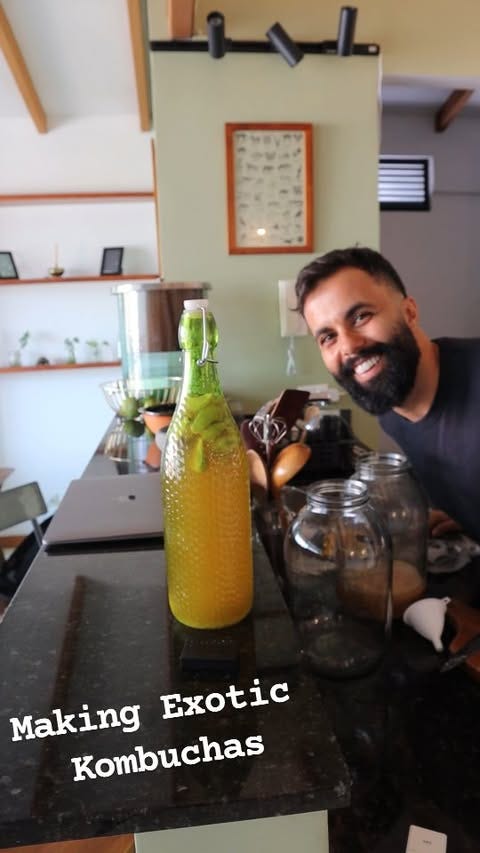
At first I was looking around for AI editor but then I realized, like writing and other creative pursuits, infusing more of yourself in the editing process is what makes it stand out.
I'd like an AI editor in the future that is more like a partner that abstracts the tools away, rather than just takes all my clips and syncs them to trendy music. I think Descript actually has a chance to do this
Parting thoughts
The moment for idea people
I've heard this from several sources, and I think it's true. It's the moment for intellectually curious idea people. You can now ship stuff really quickly, the code is almost abstracted away, so ideas now really matter. This is super exciting!
AI is average
And by average, I mean it's literally the average of all human thought. So you should expect neutral and average results. Most of the time that's what you want!
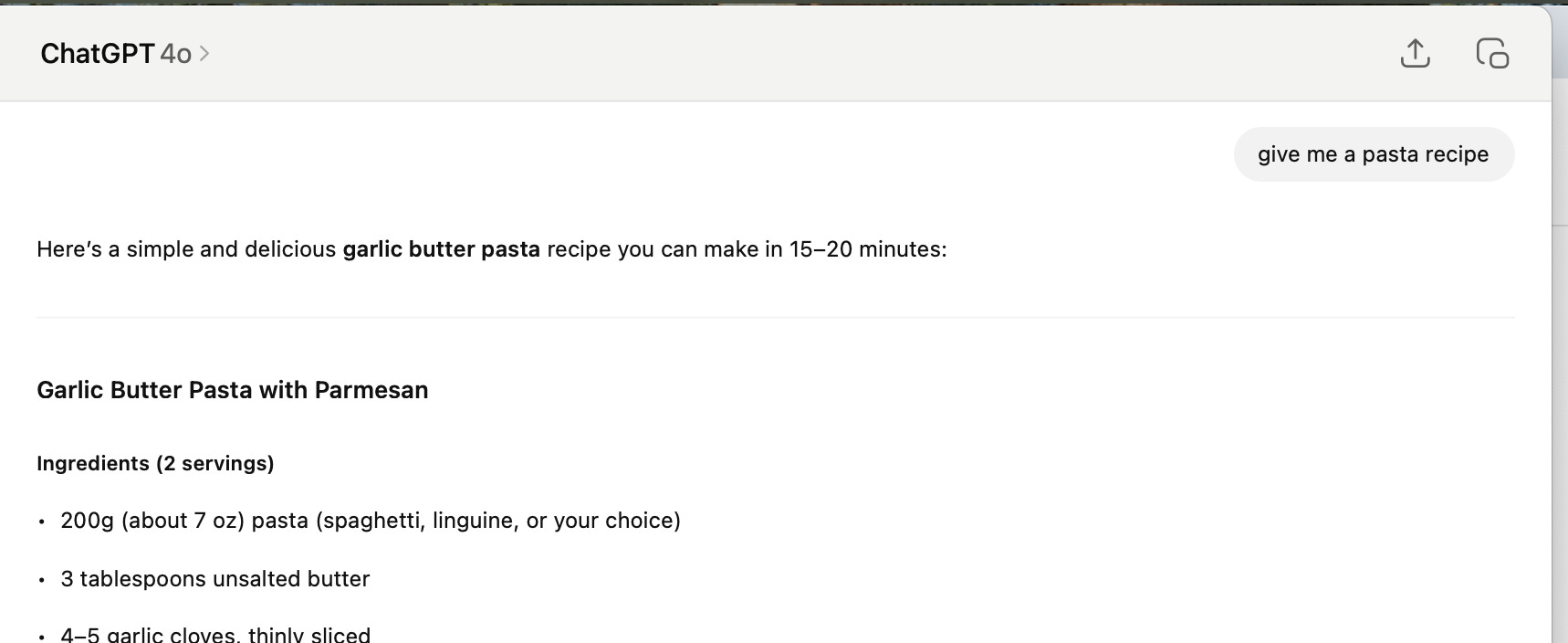
For example, if I ask it for a pasta recipe, it would pick what would satisfy most people, garlic butter or tomato basil. Not too experimental, not too basic. It's what you want most of the time.
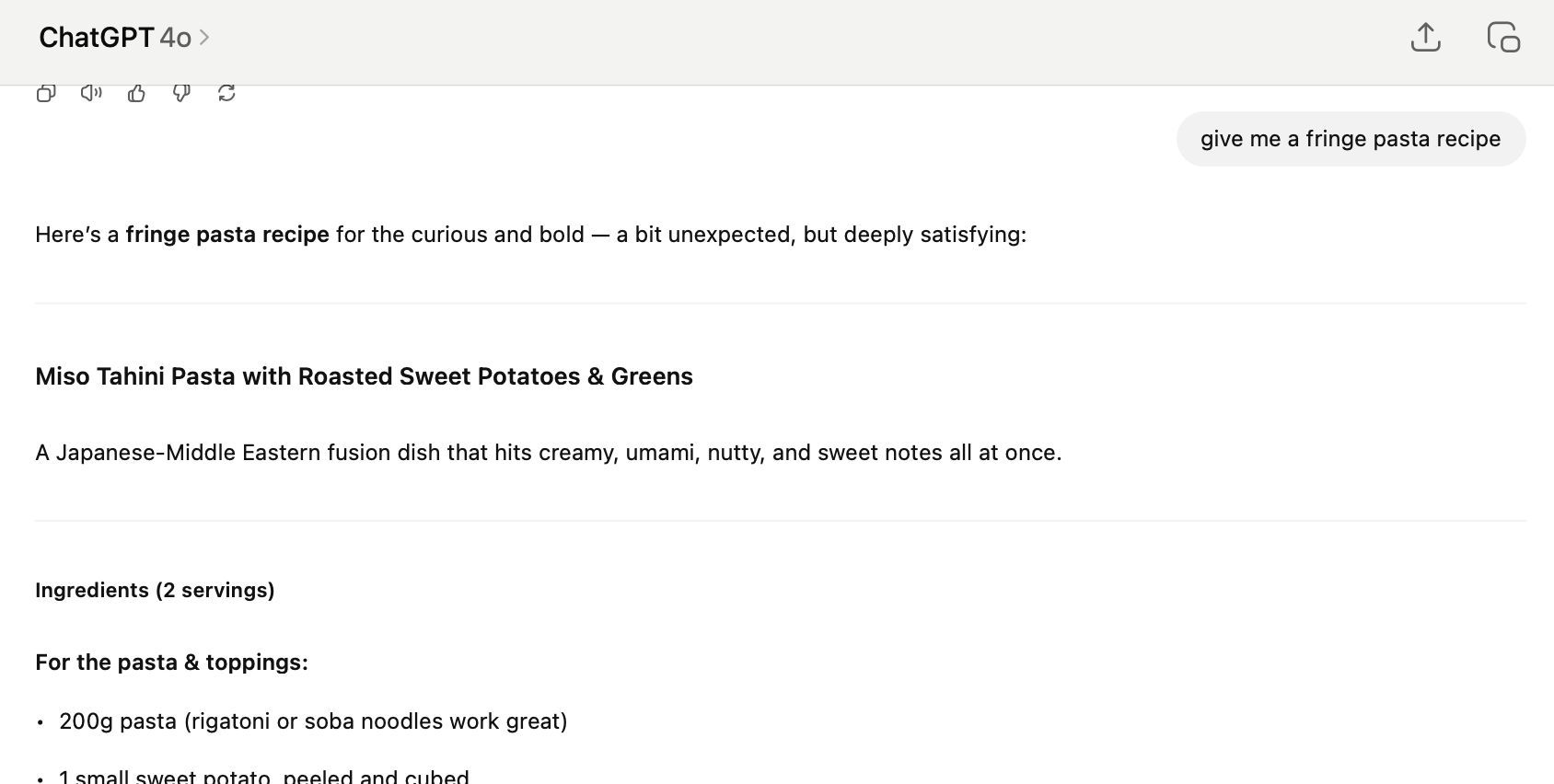
And if you do want a little fringe, you can use those words "fringe," and then you'll get the most average "fringe" (In this case it suggests Miso Tahini Pasta. I checked!)
That leads to my next point:
Context engineering
Using AI is about the context you feed it. If you have all the world's knowledge at your fingertips, what's important is what you include in your prompt.
This stands out with coding. Only including the right files and READMEs in what you want to build.
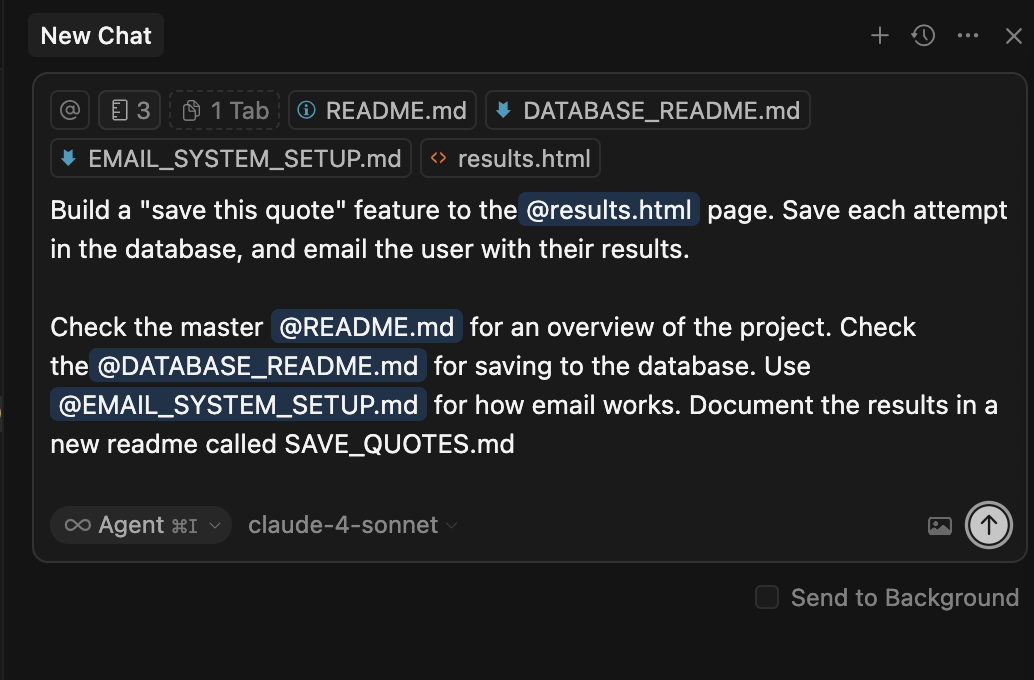
It's also equally important when you're brainstorming or strategizing (feeding the right PDFs, mentioning books and thinkers you respect and want to emulate, and especially mixing thinkers that haven't been put together before).
For example, for a marketing strategy you can say, channel Seth Godin's purple cow, use the 80/20 principle, and make sure I can execute in a month with a two-person team.
Using precise and eclectic contexts moves you away from average into interesting results.
AI is getting better quickly
I want to close with this because it's extremely important.
Something that you may have tried only a month or two ago, may now work really well.
For example, I don't think I could have pulled off that product photo transformation even 2 months ago.
With coding it's also been obvious.
When I made an app 6 months ago, it was groundbreaking that it could write code, but I also got stuck several times.
Today I would say it's AT LEAST twice as good and I'm barely getting hung up anymore.
If you want to be one of the people who has an edge with AI, try bringing it into your workflow and life regularly and build an intuition for how it's changing.
Experimenting is one of the most human things you can do!
I'd love to see you living doc of How to code with AI. As a non coder it's been fun to see some easier to use tools for vibe coding (like Replit) but I'm sure I could do more with Claude Code and for less cost.